The Gaps Agricultural Sustainability Needs to Overcome
Ask anyone responsible for an agricultural sustainability program what is getting in the way right now, and the answer usually isn’t setting a target. Increasingly, the challenge is turning those commitments into sustained execution while managing growing expectations around cost, resilience, risk, and business performance.
Most companies have already set goals around Scope 3 commitments, soil carbon targets, or regenerative acreage numbers. Many have already invested in a pilot project or multi-year program. But turning those commitments into credible, sustained progress is proving to be much harder.
Yet too many programs still hit the same barriers as they grow: fragmented data, manual workflows, outcomes that are difficult to explain or defend, rising operational complexity, and uncertainty about where to invest next.
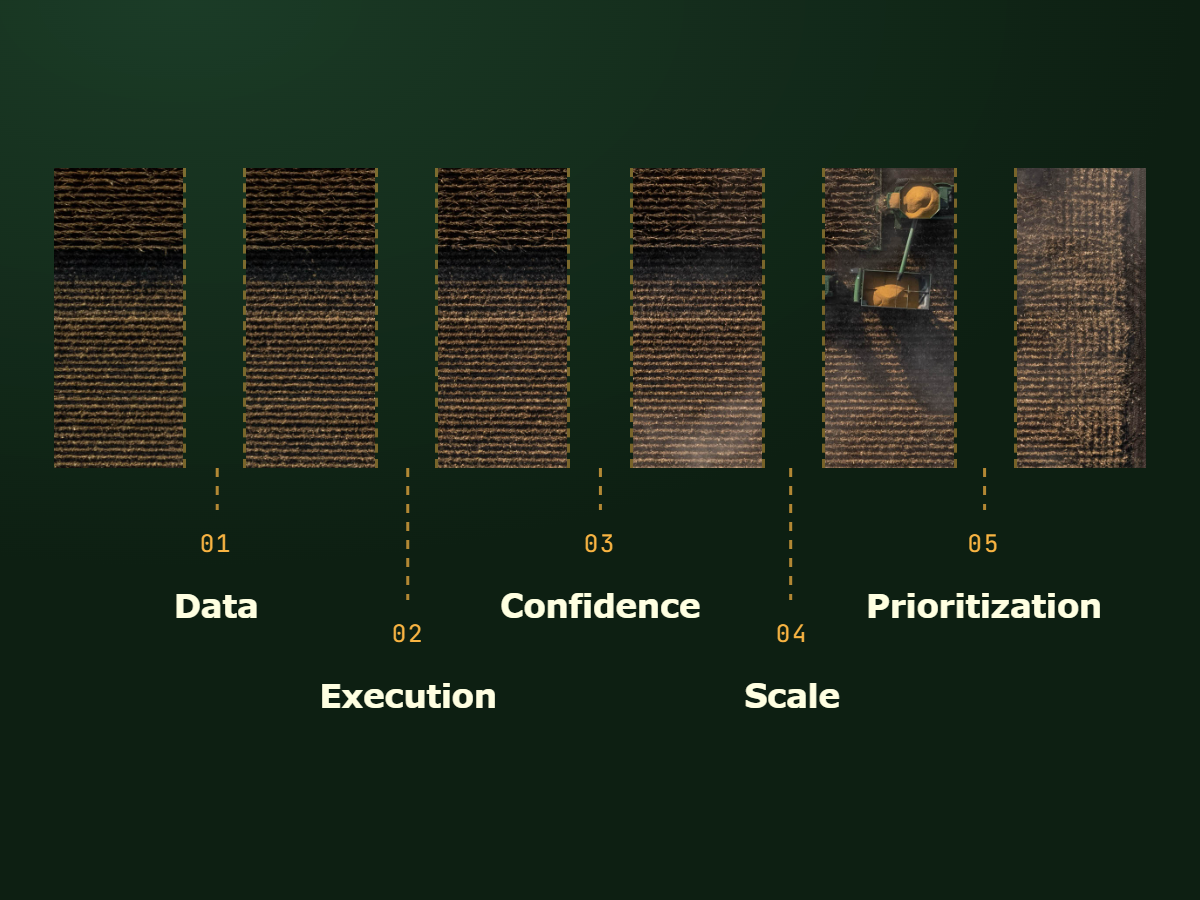
Talk to enough people running these programs, across enough companies, and the same five problems keep coming up.
The Data Gap
Everyone assumes agriculture’s data problem is a shortage of data. It’s not. The real issue is whether the data available is complete, accurate, and usable. Field records exist. Machine data exists. Remote sensing exists. But these data sources rarely come together into a coherent field-level record.
Data lives in different systems, in different formats, entered by different people at different points in the season. Some of it is missing. Some of it has errors nobody caught. By the time it reaches a model, teams are often still reconciling inconsistencies, filling gaps, and trying to determine which source to trust. That work usually falls back on the farmer or program manager through another form, another follow-up, or another round of manual review.
This delays timelines and creates additional costs. The answer is not simply collecting more data. It is making sure the data collected can be trusted, fits together, and is ready to support the modeling, reporting, and decisions that follow.
The Execution Gap
Most companies have real sustainability goals and real deadlines attached to them. But setting the target was just the beginning. Delivering against it across thousands of growers, millions of acres, multiple systems, and increasingly complex reporting requirements is where programs start to stall or break down altogether.
Programs are still run through spreadsheets, email threads, and a patchwork of disconnected systems, held together by people doing manual work - which always adds cost - that doesn’t scale in an effective way. The ambition is genuine but the infrastructure to act on it isn’t there.
Increasingly, that execution gap also determines whether sustainability investments create lasting business value or remain difficult-to-scale initiatives.
The Confidence Gap
At the end of a season or program cycle, companies receive a number: net emissions, an emissions factor, total removals, or whatever metric the program set out to measure. This is usually delivered as a static pdf or data set.
Executives, auditors, and customers are usually looking for more than just a number. They want to understand what that number means and where it came from.
What data went into it? What assumptions were made? How was the data validated? Is the methodology aligned with relevant standards? What factors influenced the result? And would it stand up to independent scrutiny?
A report with a few metrics and little explanation behind them doesn’t build confidence. It raises more questions. Outcomes need to be more than just measurable. They need to be understandable and explainable.
The Scale Gap
A pilot program with a few hundred growers can run on goodwill and manual effort. A program with tens of thousands of growers across multiple regions and crops cannot.
Plenty of sustainability programs work at a small scale. Far fewer keep working as they grow. Scaling isn't simply adding more acres and more staff to match. It's building something repeatable enough that growth doesn't require a proportional increase in cost, time, and headcount.
If a program only works when someone is nurturing each step, it isn't ready to scale.
The Prioritization Gap
Not every practice delivers the same outcome. Not every crop or region offers the same opportunity. Not every dollar invested creates the same impact.
The question is no longer just “how do we measure this?” It is “where should we focus first, where should we invest next, and where can those investments create the greatest environmental and business value?” The answer depends on crop systems, environmental conditions, supply sheds, practice opportunities, and the specific outcomes an organization is trying to achieve. Those conditions vary from one program to the next.
Knowing where to invest is becoming just as important as knowing how to measure what happens. Organizations increasingly need to understand where investments can create the greatest impact, strengthen supply resilience, reduce risk, and use those insights to inform what comes next.
Where This Leaves Us
Individually, none of these five gaps are surprising. Most people running agricultural sustainability programs have struggled with at least one—and more often several—as they work to execute effectively while maintaining enterprise support and demonstrating value.
The harder part is that these gaps don’t show up one at a time. A single program usually has to close the data, execution, confidence, scale, and prioritization gaps all at once—and keep them closed as programs, requirements, and conditions evolve.
That is why the next phase of agricultural sustainability will not be defined by who can set another target or measure another outcome. It will be defined by who can turn science, data, and commitments into decisions and execution that deliver credible environmental outcomes, strengthen resilience, reduce risk, and create lasting business value.
That's the part we've been spending our time on. More soon.